Under-sink storage that fits around the pipes
Under-sink storage that fits around the pipes: plan around your drain, cabinet hinges, and the items you need to reach most.
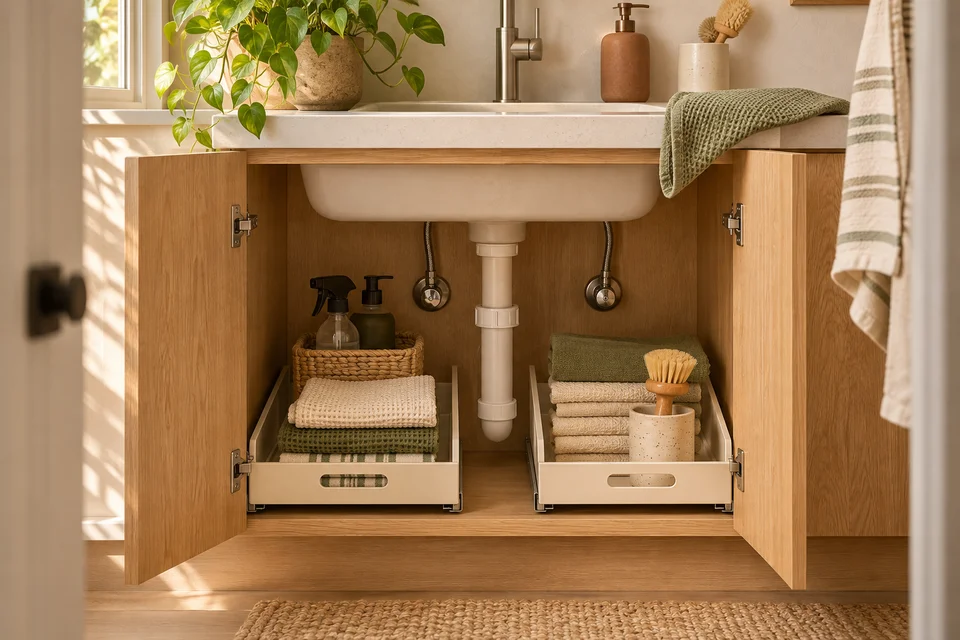
Paid link. We may earn a commission if you buy through this link.
View the Vtopmart pull-out under-sink organizers on AmazonThe width printed on a cabinet plan is only the first measurement. Under a sink, the drain, supply lines, cabinet face, and door hinges determine how much of the floor you can actually use. A simple sketch will save more time than scrolling through dozens of organizer listings.
Map the cabinet in three dimensions
Measure the opening between the hinges and face frame first. Then measure the floor left and right of the plumbing. Draw the pipes on a piece of paper and note where they are closest to the cabinet floor and front. A cabinet can have wide areas at the back that are too narrow to reach through the front.
Measure the height above the trays where your tallest items will sit. Pipes that clear the base can cross the path of a sliding basket higher up. Open each door as far as you normally can and check whether it blocks a tray when pulled forward.
Choose storage that matches the shape
Shallow bins work when the usable space is broken into smaller pockets. You can lift out one bin at a time, and separate bins are helpful if you want access to the back without moving everything. Check the rim width, since the part that sticks out can be the first thing to catch on the face frame.
A slide-out organizer is convenient for frequently used items if the cabinet gives the moving tray a clear path. Check both the height of the frame and the open depth listed by the maker. For a freestanding unit, pay attention to how the base stays planted when the tray is extended. If the unit uses fasteners, check the cabinet construction and installation instructions before you commit.
An adjustable shelf with removable panels can bridge around a drain if there is a clear place for its legs. Sketch where the panels would go; the correct overall width is little help if the uprights need to sit where the pipes are.
Leave a useful gap
Use painter’s tape or cut paper to mark the footprint of your preferred organizer. Set your tallest and largest items on that footprint and imitate the motion of sliding or lifting them out. Leave enough room to reach connections and existing shutoff handles from the front of the cabinet. Being able to remove a whole bin independently makes ordinary cleaning easier as well.
Start with one side
Try organizing the side you use most before ordering a matching pair. The pipes may leave a tall vertical space on one side and only enough room for a low tray on the other. Buy the pieces that fit each space and leave frequently used items where you can see them as soon as the door opens.
For other storage that has to fit around what is already there, see drawer organizers that actually fit and over-door hooks that let the door close.