How to choose your first claw hammer
How to choose your first claw hammer: head weight, claw shape, and handle feel, matched to the repairs you actually do at home.
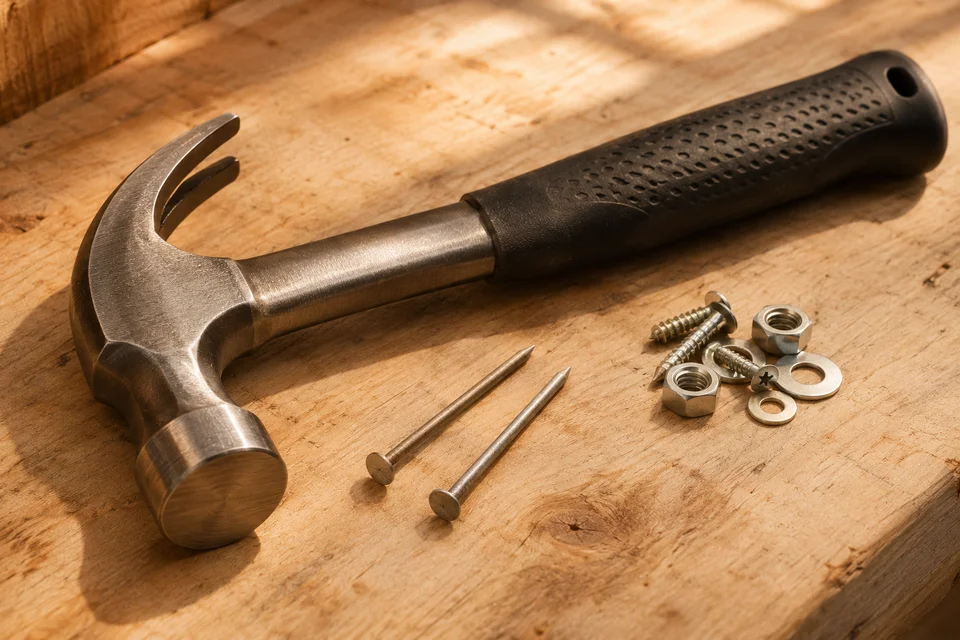
Paid link. We may earn a commission if you buy through this link.
View the Amazon Basics 8 oz claw hammer on AmazonA loose nail on a cabinet back and a nail holding two pieces of lumber together call for different amounts of force. Start with the repair you expect to do most often. That choice will tell you more about which hammer to buy than the largest weight printed on the shelf.
Start with the jobs on your list
For picture hooks and small nails, start by comparing compact or lighter claw hammers. A shorter handle can also be useful if you’re working inside a cupboard or close to a wall. For a general home kit that will see occasional wood assembly alongside small repairs, compare common 13- to 16-ounce models. You should be able to start a nail with a gentle tap and hit it repeatedly without squeezing the handle hard.
If a listing gives a weight, check whether it describes the head or the whole tool. Compare like for like. When you can hold two options in a store, pay attention to how far forward the weight feels and whether the handle end clears your wrist when you choke up for a light tap.
Pick a claw and a face
A curved claw gives you a rolling motion when pulling a nail. This is handy for occasional removal from wood. Slide a scrap of wood under the head if you need a fulcrum and want to protect the surface underneath. A straighter claw can be easier to slide behind trim where space allows. For trim you want to reuse, a thin pry bar paired with a wood shim provides a better place to start.
A smooth face makes sense for finished surfaces and general household work. A textured face can catch a framing nail head, but its pattern can leave an imprint on the wood if you overdrive the nail. If you mainly hang pictures and repair household items, a smooth face is the more useful starting point.
Compare the handle in your hand
Wood, fiberglass, and steel handles are all available in similar head weights. Check the actual grip circumference and how the balance feels with your hand near the end. Try choking up toward the head, too. A handle that feels good during a full swing may be awkward to grip during small, precise taps.
A rubberized grip can feel secure. Check for seams or a large flare that sits against your palm if your hands are small. For an online purchase, look for a photo that shows where the grip starts and ends, and make sure the retailer accepts returns if the fit is uncomfortable.
Buy for the smallest regular job
Write down your first two jobs. If they’re both picture-hanging and small household fixes, choose a manageable smooth-face claw hammer. If you regularly drive larger nails into lumber, compare the general-purpose models at the upper end of that range. Keep the heavier specialty hammer on your list until you have a job that calls for it.
For the other tools most small home repairs start with, see a tape measure for everyday home projects and a screwdriver set for small home repairs.